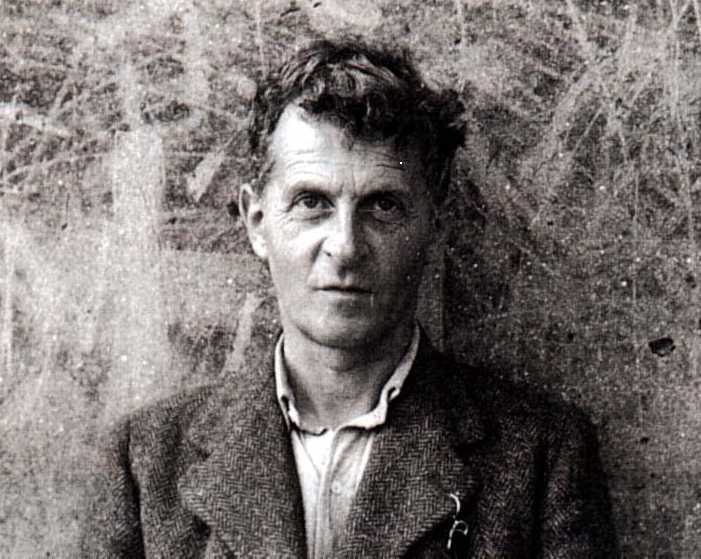
Wittgenstein, dir. Derek Jarman (1993)
Mar. 3rd, 2011 12:46 am![[personal profile]](https://www.dreamwidth.org/img/silk/identity/user.png) rushthatspeaks
rushthatspeaksI watched this this afternoon as a phone date with ![[livejournal.com profile]](https://www.dreamwidth.org/img/external/lj-userinfo.gif) sovay; all hail our DVD-synchronization capabilities, because we got it playing with no perceivable lag on either person's side.
sovay; all hail our DVD-synchronization capabilities, because we got it playing with no perceivable lag on either person's side.
After having seen the Derek Jarman films I've seen at this point (Caravaggio, Edward II, The Tempest, the short films bundled with The Tempest) and having read several of his books, I think I should have gotten the idea by now that he could do whatever he wanted to the cinema, but a biopic of Ludwig Wittgenstein did not and still does not sound like a good idea for a movie. I mean, Wittgenstein was a depressing and depressed man, his philosophy is famously impenetrable, huge portions of his extended family committed suicide, and he spent most of his life as a college professor, which is as we all know the most eminently filmable profession of all time.
Jarman could do anything. This is a funny, charming, witty, remarkably kind movie with, in fact, huge chunks of philosophy in it, expressed in easily comprehensible terms. It's not a conventional biopic in any way, it leaves out a lot of what I am sure most people would consider the necessary facts of Wittgenstein's life (such as, for instance, the date of his death), but it is one of the more successful portrait biographies I've ever seen.
For one thing, it is narrated by Wittgenstein himself, at about the age of twelve, speaking directly to the audience. This works magnificently. His twelve-year-old self (Clancy Chassay) deflates the pretensions of the adult (Karl Johnson), but is as earnest and forward-looking as a bright child can be, and is least present in the bits of the film where the man knows himself least.
Then there's the lack of set. Jarman, for budgetary reasons, for time reasons, and on account of his failing eyesight, shot the entire film with totally black backgrounds. The actors and props hover in front of void like a dream. This means that any pretense of naturalism goes entirely out the window, that one must accept that people are in the times and places they say they are in and that young Ludwig can walk past a signpost that has arrows pointing to Cambridge and to WWI and it does not come across as affectation but as a statement of fact. Wittgenstein's philosophy, his views about facts and the question of objective existence, play naturally on a canvas like this.
The philosophy plays visibly quite literally-- you won't find this out from the film, but Jarman used Wittgenstein's writings on color theory to pick the colors for all the costumes and props, and both Jarman and Wittgenstein had something there. I have never seen another film with this sort of color palette. It's incredibly neon, and it never clashes. I have no idea whether any of the colors are meant to have emotional symbolism but I could stare at this for hours because it is beautiful and very, very different.
And of course the whole thing is full of great British character actors, Michael Gough as Bertrand Russell, Tilda Swinton as Lady Ottoline Morrell in a series of ever-escalating marabou hats that have to be seen to be (dis)believed. Karl Johnson, whom I have mentioned already, is an actor I fell desperately in love with watching his Ariel in Jarman's Tempest, an Ariel so inhuman he genuinely frightens me and so beautiful it doesn't matter. Johnson looks ridiculously like Wittgenstein but keeps the fox-sharp grace of his younger self and projects both an incredible self-induced melancholy and an in-spite-of-himself lovability. (I can't find any good pictures of his Ariel online. Internet, you have failed me.)
So yeah. If I have a problem with this, it's that it's so short (an hour and a half), and that I define the semantics of the word 'riddle' differently than one of the speeches does, and that there was an element which I considered misplaced or not a good idea for nearly the entire movie which then managed to work gloriously at the very final second possible. Not as much a total frickin' masterpiece as the Jarman Edward II, which took the top of my head off, but I highly recommend this. Because somebody made a successful biopic of Ludwig Wittgenstein, and that's certainly never going to happen again.
You can comment here or at the Dreamwidth crosspost. There are comments over there.
sovay; all hail our DVD-synchronization capabilities, because we got it playing with no perceivable lag on either person's side.After having seen the Derek Jarman films I've seen at this point (Caravaggio, Edward II, The Tempest, the short films bundled with The Tempest) and having read several of his books, I think I should have gotten the idea by now that he could do whatever he wanted to the cinema, but a biopic of Ludwig Wittgenstein did not and still does not sound like a good idea for a movie. I mean, Wittgenstein was a depressing and depressed man, his philosophy is famously impenetrable, huge portions of his extended family committed suicide, and he spent most of his life as a college professor, which is as we all know the most eminently filmable profession of all time.
Jarman could do anything. This is a funny, charming, witty, remarkably kind movie with, in fact, huge chunks of philosophy in it, expressed in easily comprehensible terms. It's not a conventional biopic in any way, it leaves out a lot of what I am sure most people would consider the necessary facts of Wittgenstein's life (such as, for instance, the date of his death), but it is one of the more successful portrait biographies I've ever seen.
For one thing, it is narrated by Wittgenstein himself, at about the age of twelve, speaking directly to the audience. This works magnificently. His twelve-year-old self (Clancy Chassay) deflates the pretensions of the adult (Karl Johnson), but is as earnest and forward-looking as a bright child can be, and is least present in the bits of the film where the man knows himself least.
Then there's the lack of set. Jarman, for budgetary reasons, for time reasons, and on account of his failing eyesight, shot the entire film with totally black backgrounds. The actors and props hover in front of void like a dream. This means that any pretense of naturalism goes entirely out the window, that one must accept that people are in the times and places they say they are in and that young Ludwig can walk past a signpost that has arrows pointing to Cambridge and to WWI and it does not come across as affectation but as a statement of fact. Wittgenstein's philosophy, his views about facts and the question of objective existence, play naturally on a canvas like this.
The philosophy plays visibly quite literally-- you won't find this out from the film, but Jarman used Wittgenstein's writings on color theory to pick the colors for all the costumes and props, and both Jarman and Wittgenstein had something there. I have never seen another film with this sort of color palette. It's incredibly neon, and it never clashes. I have no idea whether any of the colors are meant to have emotional symbolism but I could stare at this for hours because it is beautiful and very, very different.
And of course the whole thing is full of great British character actors, Michael Gough as Bertrand Russell, Tilda Swinton as Lady Ottoline Morrell in a series of ever-escalating marabou hats that have to be seen to be (dis)believed. Karl Johnson, whom I have mentioned already, is an actor I fell desperately in love with watching his Ariel in Jarman's Tempest, an Ariel so inhuman he genuinely frightens me and so beautiful it doesn't matter. Johnson looks ridiculously like Wittgenstein but keeps the fox-sharp grace of his younger self and projects both an incredible self-induced melancholy and an in-spite-of-himself lovability. (I can't find any good pictures of his Ariel online. Internet, you have failed me.)
So yeah. If I have a problem with this, it's that it's so short (an hour and a half), and that I define the semantics of the word 'riddle' differently than one of the speeches does, and that there was an element which I considered misplaced or not a good idea for nearly the entire movie which then managed to work gloriously at the very final second possible. Not as much a total frickin' masterpiece as the Jarman Edward II, which took the top of my head off, but I highly recommend this. Because somebody made a successful biopic of Ludwig Wittgenstein, and that's certainly never going to happen again.
You can comment here or at the Dreamwidth crosspost. There are