![[personal profile]](https://www.dreamwidth.org/img/silk/identity/user.png) rushthatspeaks
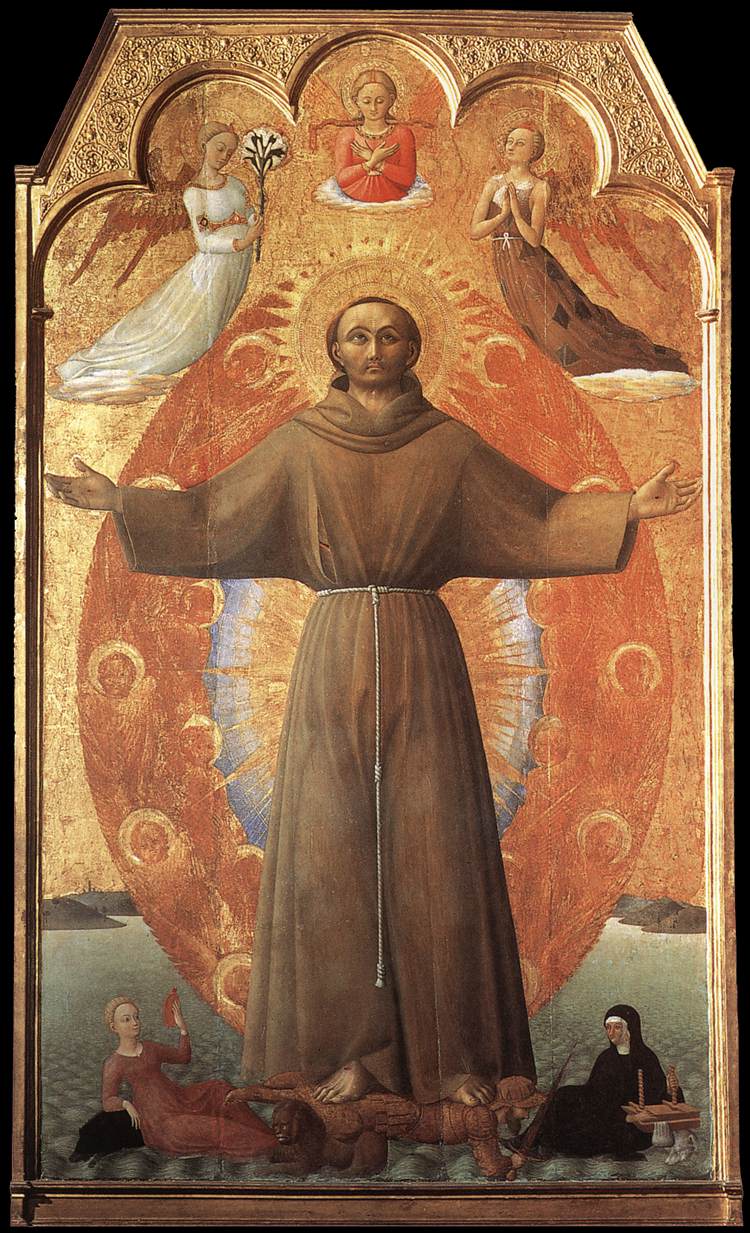
rushthatspeaksI believe we left off at the I Tatti art collection. I suspect I was standing in front of the altarpiece of St. Francis*, which is the most important and impressive piece they have and which is astounding sixteenth-century work. Francis is standing on the ocean, a la the Birth of Venus, and crushing under his feet Lust (a maiden leaning on a cinghiale, for the wild boar are the animals which multiply most uncontrollably in Tuscany), Pride (an armed warrior couched on a lion) and Avarice (an old woman counting her money while spinning, her wheel pressing on the head of a dog or she-wolf). There is an aureole around Francis reminiscent of the Venus's sea-shell, scarlet bright and filled with the heads and wings of seraphs, which makes this painting heretical as only Christ or Mary or God are entitled to seraphic encirclement. Above him hover the angels of Francis's three virtues, to whom he is mystically married: the angel of Chastity, the angel of Poverty, and the angel of Obedience. Chastity carries lilies, the symbol of virginity, and Obedience a yoke; but Poverty has bare feet, her hair down, and patches on her leather dress. Poverty's dress is amazing. It is undoubtedly going against the spirit of the painting, but everyone I know who has seen this who wears dresses would like a replica, including myself. It has a debonair, angelic air while still being decidedly leather and patchy and downmarket. (Its awesomeness only kind of comes across in the photo.)
This altarpiece is in the parlor, which as with the other house-rooms at I Tatti is decorated with priceless art in a delicate mixture of styles and periods. On the nineteenth-century cabinet in front of and below the altarpiece Berenson put eighth and ninth-century Chinese bronzes, and they fit and do not clash, because his taste was so careful and exquisite. Dark wood, red and gold brocades and rugs, graceful porcelain and metal things on the furniture; and each sacred painting has a table or shelf or cabinet before it in a position that suggests an altar. These are livable rooms, with comfortable modern chairs and couches in patterns which go with the rugs, and windows out to the gardens, and bookshelves where the books still are. It's noteworthy that when Berenson finished decorating I Tatti he stopped buying paintings, even though he could by that time have afforded work of much greater fame and notoriety than he had been able to manage when he started. He was thinking of the house, not of the museum; the people, not the historical. And yet all the documentation is there, the catalogues and provenances in the library, the books and pamphlets the villa puts out for those not fortunate enough to be able to walk through it. It is in a liminal space between public and private, library and mansion, house and college, for the director and his family do live in the closed rooms off which we admire the possible Giotto and the tenth-century Japanese screen. A window-seat looking out on a kaki tree, nook lined with volumes, and a neat little soapstone snake on the table, a cheerful place for any scholar to sit and work and fiddle with things, but the volumes are Sanskrit eighteenth-century originals and the snake is Mesoamerican and lined with purple jade: that's I Tatti, and you're still allowed to sit there.
A fact which is brought home when we finish the tour and go down for tea, because tea is in the parlor, yes that selfsame parlor, in fact the tea-carts are directly under St. Francis and I am told the morning coffee-urns actually sit on the cabinet in front of him. Thrud and I drink tea and eat tiny house-made cookies full of marzipan and bitter orange and pignoli and stare at St. Francis, and talk with the fellows and academics who have come starving out of the library woodwork to cram in some sugar before going back to the late afternoon research (the tired time of day, before dinner, and dinner is formal, with the period table and period uncomfortable chairs in the forbidding dining room full of medieval martyrs; tea is less formal and has better sofas) and we stare at St. Francis, and show them our lens-cloths with interesting pictures on them and continue to stare at St. Francis. Being permitted to eat in this room is rather like the concept of taking a picnic basket into the Louvre: it would certainly be nice if you could do it, but no one's going to let you, and even if they did, somehow, it would feel peculiar and as though you were not respecting something, or perhaps wore the wrong shoes. But here there are no wrong shoes, because the parlor is for tea and the receiving of company and that's what it was designed to do. One is left with only the faint disbelief, the desire to somehow live up to the villa. I was glad Thrud lent me some good clothes, as my usual penniless-grad-student-style attire just doesn't work at I Tatti. In such artful surroundings it feels wrong not to be polished.
Then through the quiet library, modern shelving but with urns in a set of differing sizes meant to make the spaces into one long perspective with the garden; and in the spacious reading-room there it was. The Worst Piece Of Art In Florence. I had been told to expect it but it was still hard to believe.
It's a fresco. Berenson commissioned it at some point in I think the twenties and was out of town while most of the painting happened; when he came home and saw it he threw the artist bodily out of the house, so the bottom frieze is unfinished which is really just as well. How to communicate this-- imagine poor attempts at the Impressionist brushstroke of van Gogh, with the color palette of a Wyeth, only a lot more neon, a lot of pinks and purples and acid greens in very coarse linework. Now imagine that someone has executed a lot of nudes in the classical style in this manner, but can't draw very well, and also is limited by having no realistic skin-tones in the colorways and no ability to put in fine detail given the coarseness. Also the nudes are all posed in strained and confusing poses which make it impossible to tell what they are doing, except that the gentleman at the very far right is doing downward-facing dog, on a yoga mat, despite, as I said, being obviously classical.
It's a sight to make eyes sore. They had it covered with white canvas during Berenson's lifetime but then the artist became famous and this is his largest work, so they took the canvas down. Truly and entirely worth a visit, though I feel sorry for Berenson about the thing; I think he was very restrained in his treatment of the artist, I'd probably have thrown in a punch or two for good measure.
After coming back from I Tatti, Thrud and I went to dinner at Bordino. Bordino is a hole-in-the-wall in the Oltrarno, shoved into a medieval cellar. It has truffle cream pasta which does not do the annoying thing where they shave bits of truffle over something so that it's all crunchy, but rather has the truffle infused into the sauce so the aroma and flavor come through as fully as possible; it has lobster pasta which is a perfect blend of spicy, sweet, and sea-broth; and it is where you go for bistecca alla Fiorentina. Bistecca alla Fiorentina is Florence's only claim to the world of high cuisine, for most of the food is rustic here, tripes and stews and porridges. The steak has a spice rub, but that's barely noticeable, because the important thing is how it's cooked. It's a very fatty cut, very thick, and the outside is charred, with a layer of well-done. Then as you proceed inward it becomes less and less cooked, until the center is still cool and red and untouched by heat at all. So you get all degrees of doneness in one steak, and the point is the contrast between them, which I wouldn't have thought to be as interesting as it turned out to be, but it really is, the textures, flavors, and temperatures blending in each bite. Also they serve it with lemon, which is just peculiar but certainly different. Bordino's does not break the bank, which is great because around here people charge the earth for bistecca alla Fiorentina, but no, Bordino will do you this steak dinner with primi and house wine and dolci for about thirty-five euros per person, which is ludicrous. The dolci are nothing to write home about but by that point one is too full of steak, so it doesn't matter.
* Link goes to Thrud's blog, which, as I have mentioned, you should totally read
You can comment here or at the Dreamwidth crosspost. There are comments over there.
This altarpiece is in the parlor, which as with the other house-rooms at I Tatti is decorated with priceless art in a delicate mixture of styles and periods. On the nineteenth-century cabinet in front of and below the altarpiece Berenson put eighth and ninth-century Chinese bronzes, and they fit and do not clash, because his taste was so careful and exquisite. Dark wood, red and gold brocades and rugs, graceful porcelain and metal things on the furniture; and each sacred painting has a table or shelf or cabinet before it in a position that suggests an altar. These are livable rooms, with comfortable modern chairs and couches in patterns which go with the rugs, and windows out to the gardens, and bookshelves where the books still are. It's noteworthy that when Berenson finished decorating I Tatti he stopped buying paintings, even though he could by that time have afforded work of much greater fame and notoriety than he had been able to manage when he started. He was thinking of the house, not of the museum; the people, not the historical. And yet all the documentation is there, the catalogues and provenances in the library, the books and pamphlets the villa puts out for those not fortunate enough to be able to walk through it. It is in a liminal space between public and private, library and mansion, house and college, for the director and his family do live in the closed rooms off which we admire the possible Giotto and the tenth-century Japanese screen. A window-seat looking out on a kaki tree, nook lined with volumes, and a neat little soapstone snake on the table, a cheerful place for any scholar to sit and work and fiddle with things, but the volumes are Sanskrit eighteenth-century originals and the snake is Mesoamerican and lined with purple jade: that's I Tatti, and you're still allowed to sit there.
A fact which is brought home when we finish the tour and go down for tea, because tea is in the parlor, yes that selfsame parlor, in fact the tea-carts are directly under St. Francis and I am told the morning coffee-urns actually sit on the cabinet in front of him. Thrud and I drink tea and eat tiny house-made cookies full of marzipan and bitter orange and pignoli and stare at St. Francis, and talk with the fellows and academics who have come starving out of the library woodwork to cram in some sugar before going back to the late afternoon research (the tired time of day, before dinner, and dinner is formal, with the period table and period uncomfortable chairs in the forbidding dining room full of medieval martyrs; tea is less formal and has better sofas) and we stare at St. Francis, and show them our lens-cloths with interesting pictures on them and continue to stare at St. Francis. Being permitted to eat in this room is rather like the concept of taking a picnic basket into the Louvre: it would certainly be nice if you could do it, but no one's going to let you, and even if they did, somehow, it would feel peculiar and as though you were not respecting something, or perhaps wore the wrong shoes. But here there are no wrong shoes, because the parlor is for tea and the receiving of company and that's what it was designed to do. One is left with only the faint disbelief, the desire to somehow live up to the villa. I was glad Thrud lent me some good clothes, as my usual penniless-grad-student-style attire just doesn't work at I Tatti. In such artful surroundings it feels wrong not to be polished.
Then through the quiet library, modern shelving but with urns in a set of differing sizes meant to make the spaces into one long perspective with the garden; and in the spacious reading-room there it was. The Worst Piece Of Art In Florence. I had been told to expect it but it was still hard to believe.
It's a fresco. Berenson commissioned it at some point in I think the twenties and was out of town while most of the painting happened; when he came home and saw it he threw the artist bodily out of the house, so the bottom frieze is unfinished which is really just as well. How to communicate this-- imagine poor attempts at the Impressionist brushstroke of van Gogh, with the color palette of a Wyeth, only a lot more neon, a lot of pinks and purples and acid greens in very coarse linework. Now imagine that someone has executed a lot of nudes in the classical style in this manner, but can't draw very well, and also is limited by having no realistic skin-tones in the colorways and no ability to put in fine detail given the coarseness. Also the nudes are all posed in strained and confusing poses which make it impossible to tell what they are doing, except that the gentleman at the very far right is doing downward-facing dog, on a yoga mat, despite, as I said, being obviously classical.
It's a sight to make eyes sore. They had it covered with white canvas during Berenson's lifetime but then the artist became famous and this is his largest work, so they took the canvas down. Truly and entirely worth a visit, though I feel sorry for Berenson about the thing; I think he was very restrained in his treatment of the artist, I'd probably have thrown in a punch or two for good measure.
After coming back from I Tatti, Thrud and I went to dinner at Bordino. Bordino is a hole-in-the-wall in the Oltrarno, shoved into a medieval cellar. It has truffle cream pasta which does not do the annoying thing where they shave bits of truffle over something so that it's all crunchy, but rather has the truffle infused into the sauce so the aroma and flavor come through as fully as possible; it has lobster pasta which is a perfect blend of spicy, sweet, and sea-broth; and it is where you go for bistecca alla Fiorentina. Bistecca alla Fiorentina is Florence's only claim to the world of high cuisine, for most of the food is rustic here, tripes and stews and porridges. The steak has a spice rub, but that's barely noticeable, because the important thing is how it's cooked. It's a very fatty cut, very thick, and the outside is charred, with a layer of well-done. Then as you proceed inward it becomes less and less cooked, until the center is still cool and red and untouched by heat at all. So you get all degrees of doneness in one steak, and the point is the contrast between them, which I wouldn't have thought to be as interesting as it turned out to be, but it really is, the textures, flavors, and temperatures blending in each bite. Also they serve it with lemon, which is just peculiar but certainly different. Bordino's does not break the bank, which is great because around here people charge the earth for bistecca alla Fiorentina, but no, Bordino will do you this steak dinner with primi and house wine and dolci for about thirty-five euros per person, which is ludicrous. The dolci are nothing to write home about but by that point one is too full of steak, so it doesn't matter.
* Link goes to Thrud's blog, which, as I have mentioned, you should totally read
You can comment here or at the Dreamwidth crosspost. There are